
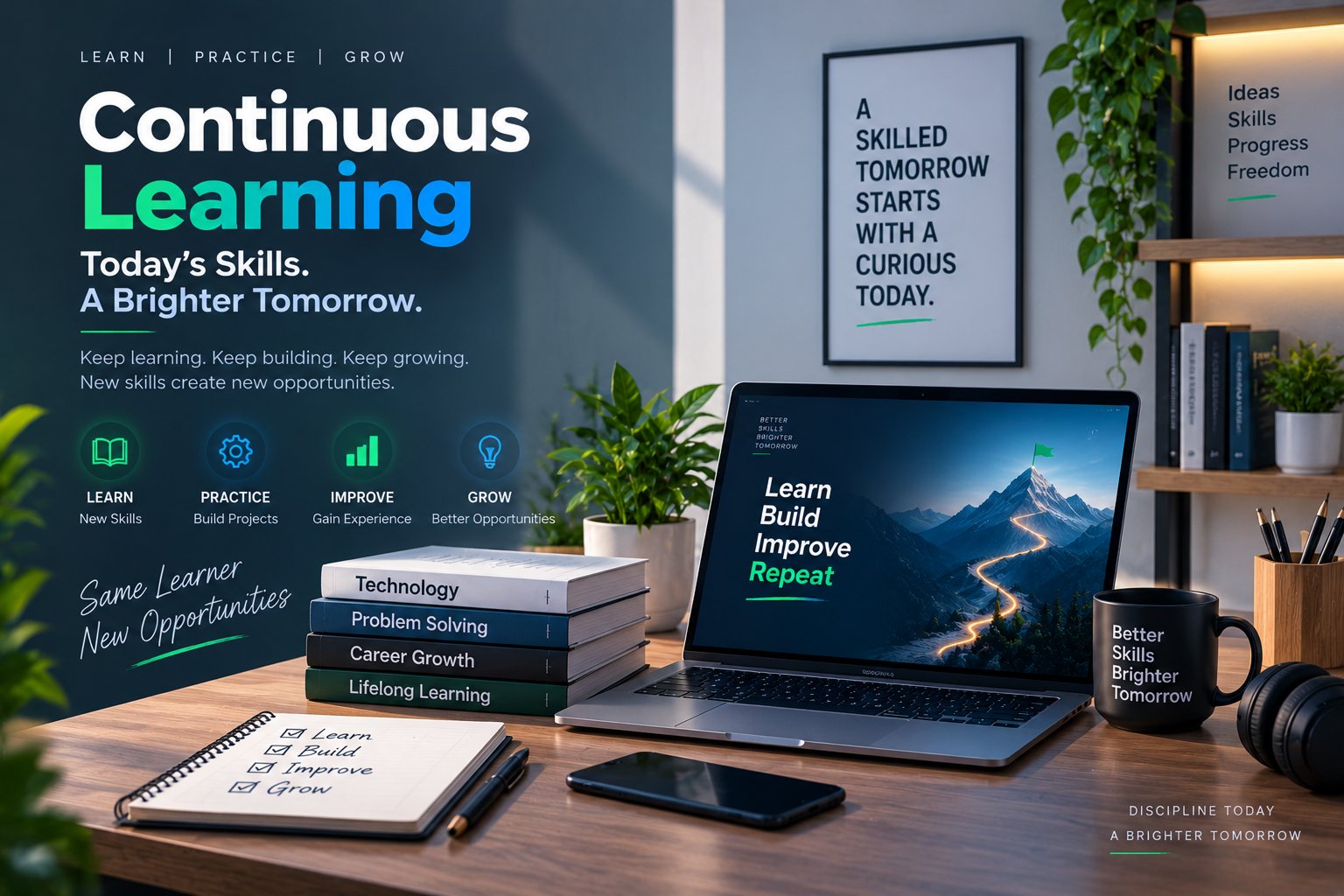
Technology has never evolved as quickly as it is today.
New programming languages emerge, AI capabilities expand, cloud platforms introduce new services, and business expectations continue to shift. A skill that is highly sought after today may become less valuable within just a few years.
Yet, while technology changes rapidly, many professionals continue to build successful and long-lasting careers.
What sets them apart?
It isn’t that they learn every new technology.
It’s that they continuously adapt.
Technology Changes. Learning Never Stops.
Many professionals believe they need to master every trending technology to stay competitive.
In reality, successful professionals focus on building a strong learning mindset rather than chasing every new tool.
Instead of asking, “What should I learn next?”
They ask, “What skill will create the most value for my career?”
Continuous learning is about making strategic choices, not trying to learn everything.
Build Strong Fundamentals
Technology stacks evolve, but core concepts remain valuable.
Professionals who understand problem-solving, software architecture, databases, algorithms, communication, and business requirements adapt much faster to new technologies.
Strong fundamentals make learning new tools easier.
The technology may change.
The ability to learn quickly becomes your greatest advantage.
Follow Industry Trends – Don’t Chase Every Trend
Every month introduces new frameworks, AI tools, and development platforms.
Trying to learn all of them often leads to confusion instead of growth.
Successful professionals monitor industry trends and evaluate:
- Which technologies are gaining enterprise adoption
- Which skills align with their career goals
- Which tools solve real business problems
They invest their time where long-term demand exists.
Keep Building Real Projects
Learning becomes valuable only when it is applied.
The professionals who remain relevant consistently build.
They create applications, automate workflows, experiment with AI tools, contribute to open-source projects, or solve real business challenges.
Practical experience strengthens technical confidence and creates stronger resumes and portfolios.
Projects demonstrate capability better than certificates alone.
Develop Skills Beyond Technology
Technical expertise opens doors.
Professional skills help you grow once you’re inside.
The most successful professionals continue improving:
- Communication
- Problem-solving
- Leadership
- Collaboration
- Business understanding
- Presentation skills
These abilities become increasingly important as careers progress into senior, leadership, or client-facing roles.
Build Your Professional Brand
Being skilled is important.
Being visible is equally important.
Successful professionals actively maintain:
- An updated LinkedIn profile
- A professional portfolio
- GitHub contributions
- Industry certifications
- Technical blogs or knowledge sharing
- Participation in professional communities
Visibility creates opportunities that technical ability alone cannot.
Embrace AI as a Career Accelerator
Artificial Intelligence is transforming nearly every industry.
Rather than viewing AI as competition, successful professionals use it to increase productivity, automate repetitive tasks, improve decision-making, and enhance creativity.
The professionals who learn to work alongside AI will often outperform those who resist change.
Technology doesn’t replace adaptable professionals.
It empowers them.
Final Thoughts
The technology market will continue to evolve.
Programming languages will change.
Frameworks will change.
Business requirements will change.
But one quality will always remain valuable:
The willingness to learn, adapt, and grow.
The professionals who stay relevant are not the ones who know everything.
They are the ones who never stop learning.
Because in today’s technology market, your greatest competitive advantage isn’t a single skill.
It’s your ability to continuously develop new ones.
